

Outline the production, release and fate of catecholamines at the sympathetic nerve terminal
Production
- Phenylalanine is converted to tyrosine in the liver
- Tyrosine is transported into the axon via sodium dependent transport
- Tyrosine is converted to L-DOPA via tyrosine hydroxylase
- this is the slowest step in the pathway and is hence known as the rate limiting step
- L-DOPA is converted to dopamine via dopa decarboxylase
- VMAT-2 (vesicular monoamine transporter 2) packages dopamine into vesicles
- Dopamine is converted to noradrenaline via dopamine β-hydroxylase (adds a hydroxyl group to the β-carbon)
- In sympathetic nerves, this process ends here. However in chromaffin cells of the adrenal gland:
- 20% of cells produce noradrenaline in small dense granules
- 80% of cells produce noradrenaline which is methylated to adrenaline in larger, less dense granules
- methylation is via phenylethanolamine-N-methyltransferase (PNMT)
- metenkephalin (aka opioid growth factor - OGF) is also produced
Release
- An action potential propagates through a sympathetic neuron and depolarises the presynaptic axon terminal
- → presynaptic voltage-gated N-type Ca channels open
- → Ca2+ influx which activates SNARE proteins
- SNARE proteins facilitate the exocytosis of the vesicles into synapse — mostly noradrenaline with a small amount of dopamine and adrenaline
Fate
-
Reuptake
- after release, catecholamines return to the presynaptic neuron where they may be metabolised or released again
- reuptake of noradrenaline is via NET (norepinephrine transporter)
- reuptake of dopamine is via DAT (dopamine transporter)
-
Neurotransmission
- binds to postsynaptic adrenergic receptors, producing an effect in the target tissue
- e.g. α1 → smooth muscle contraction
- e.g. β1 → inotropy
- e.g. β2 → smooth muscle relaxation
- binds to presynaptic adrenergic receptors
- α2 → ↓cAMP → negative feedback loop that inhibits further neurotransmission
- β2 → ↑ cAMP → positive feedback loop that stimulates further neurotransmission
- binds to postsynaptic adrenergic receptors, producing an effect in the target tissue
-
Diffusion away from the synaptic cleft
- catecholamines diffuse into the bloodstream, after which they may be metabolised
-
Metabolism
- at the nerve terminal (major pathway)
- catecholamines are metabolised first by MAO which is bound to the outer mitochondrial membrane in the presynaptic nerve terminal
- then diffuses into circulation where it is metabolised again by COMT, which is present in many tissues such as the liver, kidneys and vascular endothelium
- MAO is also in present in other tissues such as gut, liver, kidneys and vascular endothelium
- after diffusing away
- catecholamines diffuse into the systemic circulation where they are metabolised by COMT and MAO in the various tissues where these enzymes exist, predominantly the liver
- at the nerve terminal (major pathway)
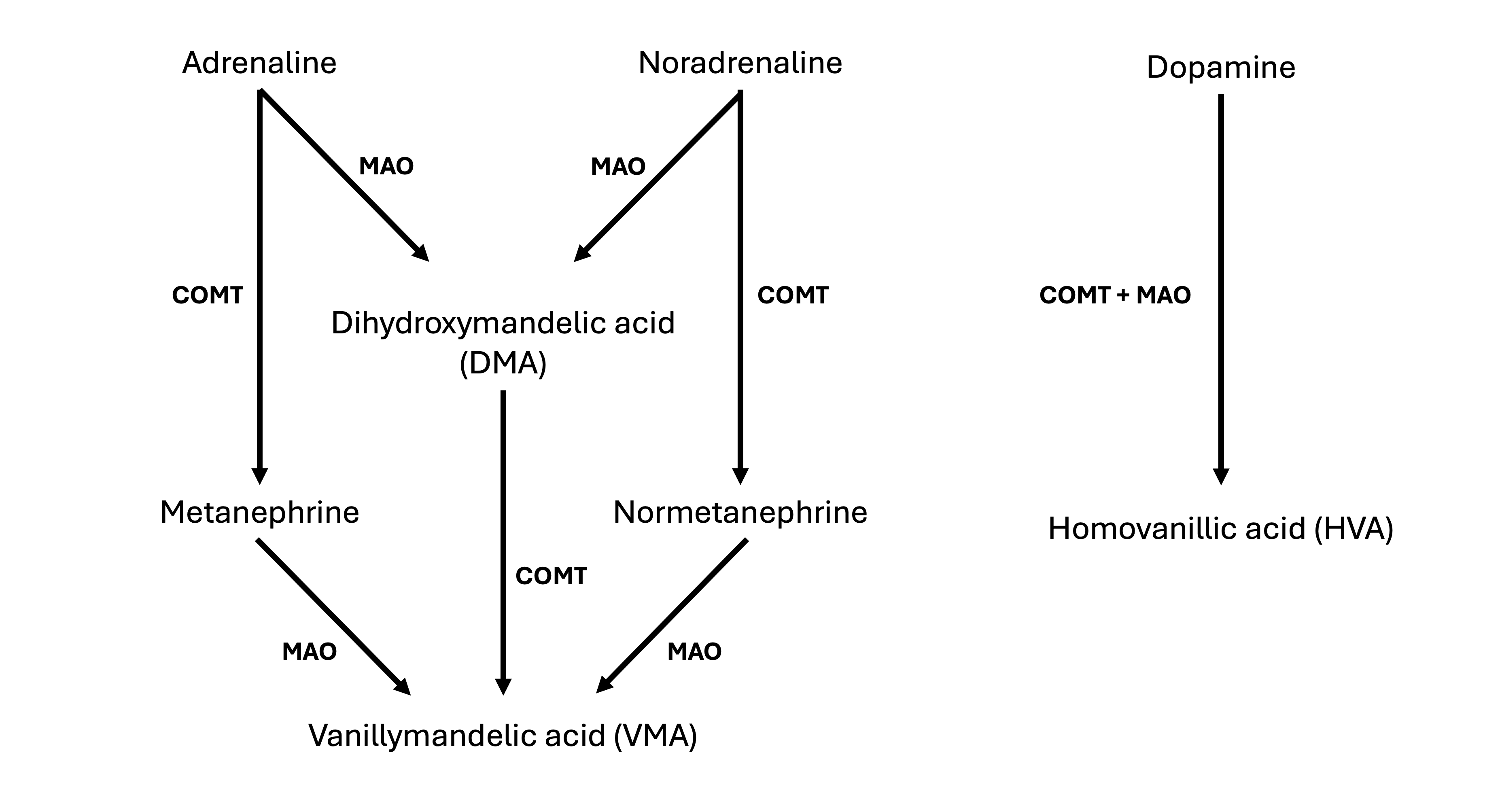
Catecholamine metabolism
ON THIS PAGE