

The Gibbs-Donnan effect
What is it?
The Gibbs-Donnan effect helps us understand how charged particles behave in several important environments:
- plasma vs interstitial fluid (main impermeant particle is plasma albumin)
- intracellular vs extracellular fluid (main impermeant particles are intracellular proteins)
- across a haemodialysis membrane
The Gibbs-Donnan effect describes how charged particles move across a semipermeable membrane when one side contains non-diffusible (impermeant) particles.
The most abundant and relevant non-diffusible particles are intracellular proteins, which are negatively charged.
The accumulation of negatively charged intracellular proteins creates an electrical gradient across the cell membrane.
- this gradient attracts cations into the cell and repels anions out of the cell
- this contributes to a greater intracellular cationic concentration (e.g. K+) and greater extracellular anionic concentration (e.g. Cl-)
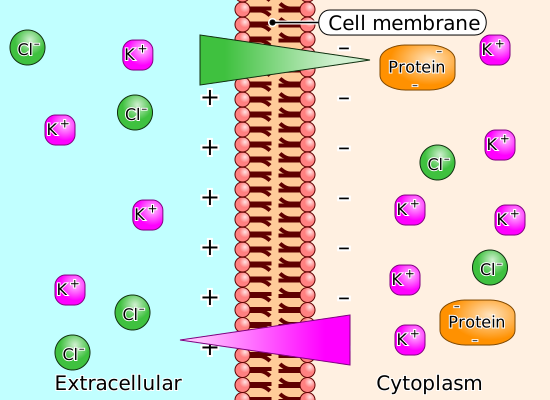
The Gibbs-Donnan equilibrium
If these processes were to reach equilibrium, known as the Gibbs-Donnan equilibrium, the product of ion concentrations on either side of the membrane would be equal.
Alternatively expressed as:
If cells reached the Gibbs-Donnan equilibirium, the concentration of intracellular solute would be high, owing to the high intracellular protein content and influx of cations. Water would flow into the cell along its osmotic gradient, leading to cell lysis.
In reality the Gibbs-Donnan equilibirium is never reached in normal physiology. It is a passive process that is overcome by active processes that create electrochemical gradients, as well as selective ion permeability. This is mostly via the Na/K-ATPase pump, which produces a net cationic flux out of the cell, opposing the Gibbs-Donnan effect.
A damaged cell may lose its membrane integrity. If this happens, and ions can pass freely in and out of the cell, the effect of ATPase pumps will be lost and the Gibbs-Donnan effect will be relatively unopposed.
To neutralise the negative charge inside the cell, cations will rush inward to reach the Gibbs-Donnan equilibrium. The resulting increase in intracellular solute concentration causes water influx, leading to tissue swelling.
This mechanism is implicated in cerebral oedema caused by brain injury.
Why does it matter?
The Gibbs-Donnan effect contributes to various important bodily functions:
- its effect on the movement of charged particles contributes to the resting membrane potential
- intracellular cations serve important cellular functions (K+, Mg2+)
- intracellular solute promotes inward flux of water