

Heat and temperature
Define heat and temperature
Heat
- the transfer of thermal energy from a warmer substance to a cooler substance due to the temperature difference between them
- thermal energy refers to the total kinetic energy of the particles within a substance
- measured in Joules/calories
Temperature
- measure of the average kinetic energy of the molecules within a substance
- measured in Kelvin (K) or degrees Celsius (°C)
Describe the mechanisms of heat loss
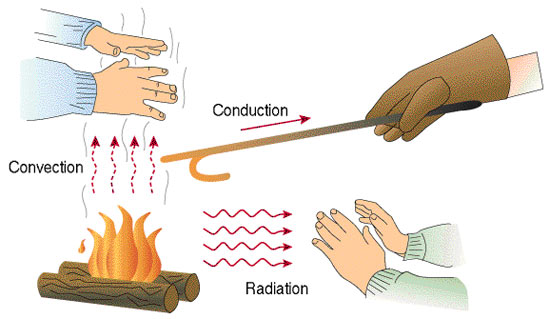
Mechanisms of heat transfer.
By cmglee, licensed under CC-BY-SA 4.0
1. Radiation (40% of total heat loss)
Transfer of heat via electromagnetic radiation from the body to the environment.
2. Convection (30% of total heat loss)
Heat transfer via movement of air or fluid, for example across the skin.
Example
- When using a fan, heat is lost to the air.
- The fan pushes the warmed air away, replacing it with cooler air.
- The cooler air can gain heat from the body again, and the cycle continues.
The same can be said about blood flow
- When warm blood reaches the skin, heat can be transferred from blood to the air.
- Blood leaving the skin is cooler, but is replaced by new warm blood.
- The faster the blood flow, the more heat can be transferred to the environment.
Hence convective heat loss is increased by cutaneous vasodilation and decreased by cutaneous vasoconstriction.
3. Evaporation (30% of total heat loss)
Heat loss that occurs when water changes from liquid to vapour. This process consumes energy (through the latent heat of vaporisation) which is drawn from the body.
Occurs mainly via
- skin (20% of total heat loss)
- mainly through sweating
- respiration (10% of total heat loss)
- 8% from evaporative loss through humidifying inspired air
- 2% from convection as warmed air is exhaled
- these mechanisms are augmented by hyperventilation
- minor sources
- gut mucosa
- urine
- lacrimation
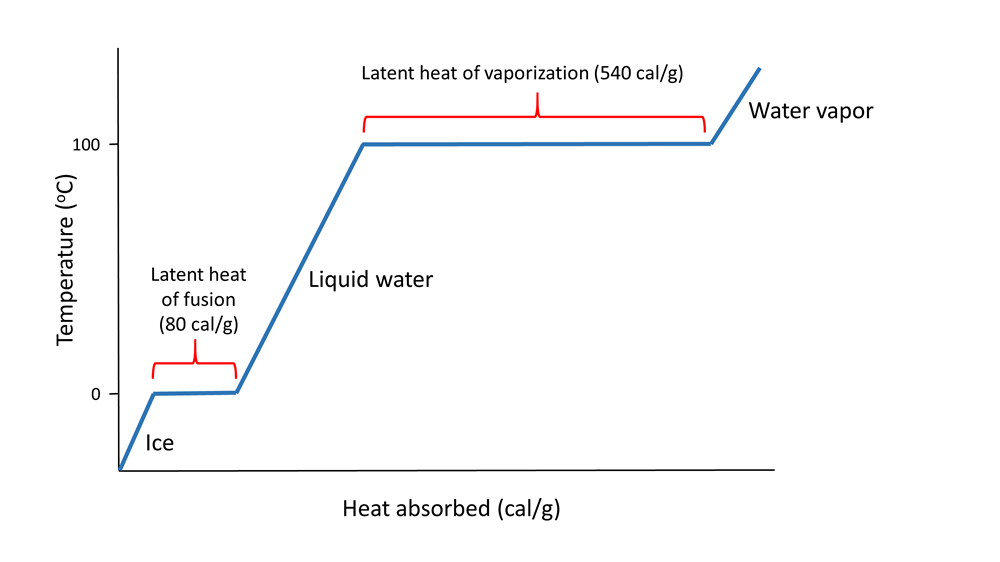
The latent heat of vapourisation refers to the energy required to turn water from liquid to vapour, which does not cause an increase in temperature. The latent heat of fusion is the energy required to turn water from ice to liquid.
Diagram by Paul Webb, licensed under CC-BY 4.0
4. Conduction
Direct transfer of heat between the body and a cooler solid surface.
For example lying on a cool bed or floor.
Contributes minimally to total body heat loss.
The mechanisms outlined above work they same way as the space heaters or coolers you may have in your home.
Infrared (radiant) heaters emit electromagnetic radiation to warm objects (or you) directly, rather than heating the air.
Convection heaters (such as the common fan-heater) blow warm air around the room, transferring heat into objects they encounter. Conventional fans and air conditioners also work through convection.
Evaporative coolers draw hot, dry air through water soaked pads which cools the air as the water evaporates. They then move this air through your home.
Conduction heating works via direct contact, for example heated seats in a car or a heated towel rail.