

Viruses
Definitions
| Term | Definition |
|---|---|
| Nucleic acid transcription | Formation of mRNA from a nucleic acid strand e.g. DNA via RNA polymerase |
| Nucleic acid translation | Synthesis of proteins from mRNA which occurs in the host cytoplasm |
| DNA virus | A virus whose genome is encoded in DNA which can be single stranded (ssDNA) or double stranded (dsDNA) Viral DNA is transcribed to mRNA in the host nucleus, then translated to synthesise viral proteins in the host cytoplasm |
| RNA virus | A virus whose genome is encoded in RNA which can be single stranded (ssRNA) or double stranded (dsRNA) ssRNA can be positive sense or negative sense |
| Positive sense RNA | Functionally the same as mRNA and can undergo translation for protein synthesis |
| Negative sense RNA | An RNA strand that is 'written' in the opposite direction to mRNA A complementary positive sense RNA strand must be transcribed via RNA polymerase before translation for viral protein synthesis |
| Retrovirus | An RNA virus that contains a reverse transcriptase enzyme which makes a complementary DNA copy of its viral RNA, which is then integrated into the host's DNA |
| Viral capsid | A protein shell that encloses the viral genome All viruses have a capsid |
| Viral envelope | A protective phospholipid bilayer that protects virus, made from the part of the host cell membrane with inserted viral glycoproteins Viruses with an envelope are called enveloped viruses Not all viruses have an envelope |
| Naked virus | A non-enveloped virus |
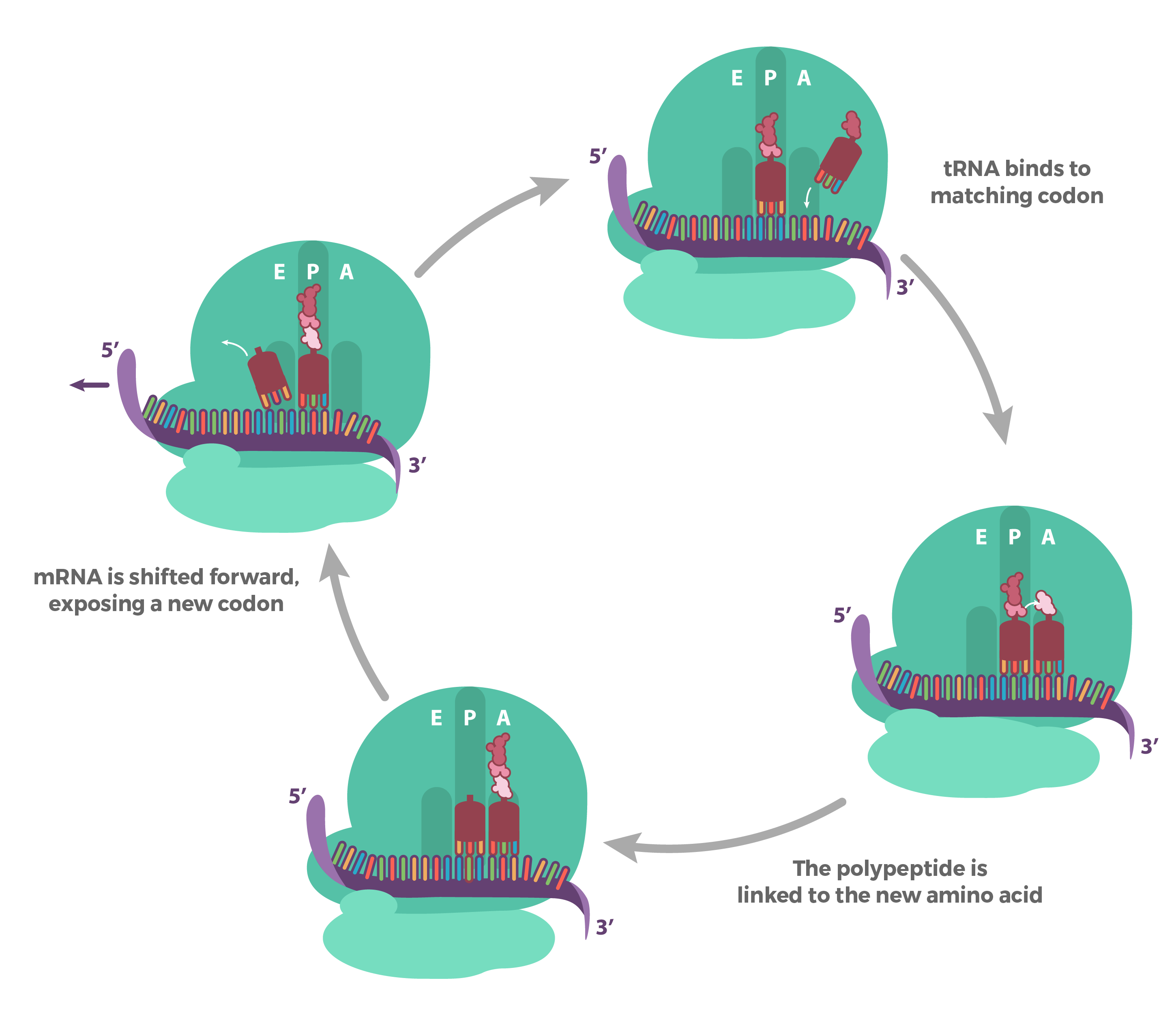
mRNA is translated to synthesise proteins with the assistance of tRNA
By Khan Academy CC-BY-SA 4.0
Classify viruses with examples
There are many classification sytems for viruses. The Baltimore system is one such example:
Group I - double-stranded DNA (dsDNA)
Viruses whose genome is encoded in dsDNA which is transcribed to mRNA in the host cell cytoplasm before translation to synthesise viral proteins.
Examples:
- naked: adenovirus
- enveloped: herpesviruses (HSV, HZV, CMV, EBV)
Group II - single-stranded DNA (ssDNA)
Viruses whose genome is encoded in ssDNA which is transcribed to mRNA in the host cell cytoplasm before translation to synthesie viral proteins.
Examples:
- naked: parvoviruses (Parvovirus B19)
- enveloped: HHPV1, HRPV1
Group III - double-stranded RNA (dsRNA)
Viruses whose genome is encoded in dsRNA.
Example: reoviruses (rotavirus) (naked)
Group IV - positive-sense ssRNA, (+)ssRNA
Viruses whose genome is encoded as positive-sense RNA which is directly translated to synthesise viral proteins.
Examples:
- naked: picornaviruses (enteroviruses, rhinovirus, HepA, polio), HepE
- enveloped: coronarviruses (SARS, MERS, COVID)
Group V - negative-sense ssRNA, (-)ssRNA
Viruses whose genome is encoded as negative-sense RNA. A complementary positive sense RNA strand must be transcribed via RNA polymerase before translation for viral protein synthesis.
Examples:
- influenza A and B, ebola (enveloped)
Group VI - reverse-transcription ssRNA (ssRNA-RT)
ssRNA viruses with reverse transcription (via reverse transcriptase) to a DNA intermediate, which is integrated into host cell DNA. The host cell assumes the viral DNA is part of its own genome, using it to synthesis viral proteins.
Example: HIV (enveloped)
Group VII - reverse-transcription dsDNA (dsDNA-RT)
dsDNA viruses with reverse transcription (via reverse transcriptase). These viruses first use the host cell's reverse transcriptase to form an RNA intermediate. The viral reverse transcriptase then converts this to DNA, which is integrated into host cell DNA.
Example: Hepatitis B (enveloped)

By Emmanuel Boutet CC-BY-SA 2.5 via Wikimedia Commons